ChangeProject ManagementDigital Transformation

That second kick of the mule

That second kick of the mule

"There is nothing to be learned from the second kick of a mule." — usually credited to Mark Twain

I've spent around three decades leading technology-driven change, and I've been writing about why it's so difficult for 10 years. This piece is about one stubborn pattern that we all keep seeing, and why I'm now building Synapsefy, an organisational memory for project risk and learnings, to do something about it.

Organisations tend to operate in between two states. In 'Business as Usual (BAU)', the system is in equilibrium, and the goal is to keep it there. In 'Change', the goal is to move it to somewhere new, to meet a new regulation or simply to stay competitive. Through a systems-thinking lens, the problem is fairly clear. The feedback loops, structures and incentives that make BAU work are the same ones that resist change. That's why change so often stalls or fails outright.

There's an associated cost of getting it wrong.

In the UK, failing to change effectively is one of the most expensive problems that organisations face, and one of the least discussed.

In the public sector, NISTA's latest Major Projects Annual Report rates 18% of the Government Major Projects Portfolio as "red", meaning successful delivery appears unachievable. Those projects account for £244bn of whole-life cost, and the red-rated share has roughly doubled in two years. This follows a long line of write-offs, from the £11bn NHS National Programme for IT to the £469m FiReControl project. The National Audit Office has described "a consistent pattern of underperformance" spanning 25 years.

The private sector fares little better. Recent research from Emergn estimates that large UK businesses lose around £67bn a year on transformation and AI initiatives that fail to deliver.

Technology adoption has accelerated over the last 20 years, and again since GenAI went mainstream in late 2022. But while the technology changes, the causes of failure don't. Sponsors, the C-suite and delivery teams make the same mistakes. Organisational memory is short: the reasons for failure have usually occurred before, in similar circumstances, in the same industry, chasing the same end objective — and yet we repeat them. That's the second kick.

Three root causes

Our research points to three root causes that reinforce one another.

Cultural. Sponsors and stakeholders rarely prioritise strategic foresight. Even when a project carries significant risk of failure, behaviours tend to stay the same, and many senior stakeholders are unaware of their own responsibilities. Project managers are left isolated and overburdened: accountable for risk, but without the authority to enforce the actions that would avoid it. High staff turnover and heavy reliance on outside consultants or contractors exacerbate the problem — they take the learnings with them. What the organisation knows about its risks, and how it treated them, is routinely lost and then painfully rediscovered.

Procedural. The processes that are meant to counter this are weak. Failure avoidance is often confined to a small group inside the project team rather than shared across stakeholders. Projects and programmes are often initiated before anyone has considered the lessons from previous failures. Real learnings are rarely captured, and even more rarely applied as the work goes on, so the same issues resurface project after project.

Technological. Underpinning both is a tooling gap. In our survey, 97% of organisations relied on office productivity tools such as spreadsheets, which were never designed for this work. They encourage subjective scoring, give organisational learning nowhere to accumulate, and offer no way to carry risks and mitigations forward into the next project. Existing risk tools are good at recording risk. What's missing is something that carries the learning forward from one project to the next.

None of this is down to carelessness. In my experience the people involved are conscientious, busy and under real pressure. The lesson exists; it just isn't there at the moment it would help. As organisations, we're rather good at writing lessons down and not nearly so good at learning them, whether they're our own or someone else's.

The hot stove

Twain had a second observation that I think matters just as much:

"We should be careful to get out of an experience only the wisdom that is in it — and stop there; lest we be like the cat that sits down on a hot stove-lid. She will never sit down on a hot stove-lid again — and that is well; but also she will never sit down on a cold one anymore." — Following the Equator (1897)

Once bitten, twice shy. When organisations do learn from a failure, they often learn too much. One bad experience with a supplier, a technology or a way of working, and it becomes "we don't do that here", long after the reasons have gone. Nobody remembers why; everyone remembers to be wary. The hot stove becomes every stove.

So, there are two ways to get it wrong: not learning at all, or learning the wrong lesson so firmly that we stop taking sensible, calculated risks. The goal isn't to take less risk. It's to take the right risks, knowingly. When it's a hospital system, a public infrastructure project or a major change programme, we all pick up the bill, in money, in time and in public trust.
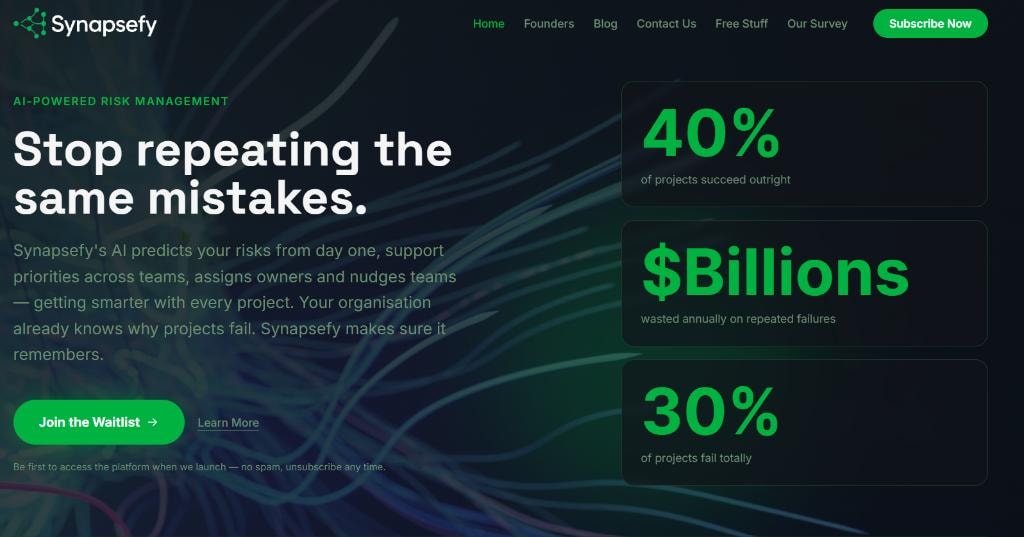
Synapsefy — organisational memory for project risk

What Synapsefy does

That's what I'm building Synapsefy, here in Northern Ireland, to help with. In plain terms, it's an organisational memory for risk. When a new project starts, it flags the likely risks based on what didn't work previously and then ensures 'ownership'. Each project then adds to that memory, so the next team starts a little better informed than the last. Crucially, it carries the reasons, the mitigations, as well as the warnings, so a team can tell a hot stove from a cold one.

Synapsefy learns from the organisation's own project history, and pooled dataset, whilst ensuring that organisational confidential project data is protected.

As a solid 'tech optimist', I'm fairly sure this isn't mainly a technology problem. It's a human one. Most of us ignore advice that feels like being told off, and act on advice that feels like a word from a helpful colleague. So, we're designing Synapsefy with behavioural science in mind: suggestions rather than instructions, always open about why something has been flagged, and always the team's call in the end.

Where we are, and what I'm asking

I should be honest about where we are. Synapsefy is at proof-of-concept stage, there's a great deal still to learn, and no doubt we'll make a few mistakes of our own. I'll share those too; it would be an irony not to.

We're building it with and for the people who carry change risk: Project & Programme Managers, PMOs and portfolio leads, transformation directors, programme sponsors, SMEs and risk owners.

If you've ever sat in a lessons-learned session thinking "we've been here before", I'd be very glad to hear from you. I'm looking for a small number of volunteer organisations to help shape Synapsefy on real projects. If you are responsible for change in your organisation, via programme/projects, and failure keeps you up at night, please get in touch. A coffee and a conversation would be a great place to start.

References: Highways Magazine: NISTA major projects rated unachievable; BCIS: NISTA report findings; Civil Service World: Red-rated schemes now worth £198bn; The Register: NAO on 25 years of government IT; The Register: NHS IT failures; Parliament: Failure of FiReControl; IT Brief UK: £67bn on failed AI work; Management Today: Axelos £250bn; Global Security Mag: Fujitsu Digital PACT; BetaNews: 6point6 agile report; Pinsent Masons Out-Law: KPMG survey.


AIAutomationFuture of Work

About ChatGPT

About ChatGPT

ChatGPT is a powerful language model developed by OpenAI that has the ability to generate human-like text.

ChatGPT interface
ChatGPT interface

One of the most significant impacts of ChatGPT is its ability to assist with a variety of tasks. It can be used to generate written content, such as articles, blog posts, and even entire books. It can also be used in customer service, as a virtual assistant, or even in creative writing. This technology can also be used to improve the accuracy of machine translation, to assist in coding and programming, and to help with natural language processing tasks.

Another impact of ChatGPT is its ability to improve the efficiency of certain tasks. For example, it can be used to automate the generation of reports, summaries, and other written documents. This can save time and reduce the need for human input, allowing organizations to focus on more important tasks.

Additionally, ChatGPT has the potential to create new job opportunities. The technology can be used to assist with tasks that would otherwise be too time-consuming for humans to complete, allowing for the creation of new roles such as chatbot designers and trainers, language engineers, and AI content creators.

However, it's important to note that ChatGPT, like any other AI technology, is not without its limitations. As it is trained on the internet text, it can reproduce the biases that exist in the data it was trained on. Therefore, it's crucial to use this technology with caution and ensure that it's used ethically. Furthermore, ChatGPT is not able to understand the context and emotions of human interactions, which is something that humans excel at, and it's important not to replace human interactions with this technology.

In conclusion, ChatGPT is a powerful language model that has the potential to assist with a wide range of tasks and improve the efficiency of certain tasks. It also has the potential to create new job opportunities. However, it's crucial to use this technology with caution and ensure that it's used ethically, and not to replace human interactions with this technology.

Don't believe me? Full disclosure, this blog was written completely by ChatGPT. All I did was asked a question and suggested a tone of voice.

AIAutomationChangeDigital TransformationFuture of WorkPeople

Artificial Intelligence, Automation & Marxism

Artificial Intelligence, Automation & Marxism

Karl Marx has a bad rep! Especially if you combine his views on social, political, and economic theory, that is Marxism, with Leninism. It's estimated that the Marxist-Leninism ideology accounted for ranging for between 10–20 million and 148 million deaths, and in today's world, there's no doubt about the absolute failure of the ideology. However, Marx did make some observations that we now know intuitively to be true, and whilst nearly 200 years ago they may have stood in stark contrast to the direction that the Second Industrial Revolution was taking the world, at least one of his ideas remains very relevant as we enter the Fourth Industrial Revolution.

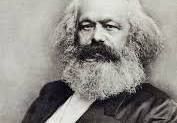
Karl Marx 1818–1883
Karl Marx 1818–1883

Karl Marx believed that work under capitalism could be alienating and monotonous, which could make it boring and unfulfilling for workers. He argued that under capitalism, workers are treated as mere cogs in a machine, forced to perform repetitive and meaningless tasks without any control over the production process. He believed that this type of work could lead to alienation, where workers feel disconnected from their own labour and the products they produce. Marx believed that this alienation could lead to a sense of hopelessness and despair among workers, as they feel trapped in a system that does not value their contributions or allow them to achieve their full potential. Whilst written at a time when factory work was on the rise, the kind of work that we know to be monotonous, even today's office-based workers feel that sense of alienation as they shift knowledge around the organisation.

Marx proposed that a socialist society would eliminate the alienation and boredom associated with work under capitalism by allowing workers to have more control over the production process and to share in the benefits of their labour. In a socialist system, workers would have greater autonomy and control over their work and would be able to take pride in the products they produce, leading to a more fulfilling and satisfying work experience. Karl Marx's vision for work was centred around the idea of human liberation from the drudgery and monotony of labour under capitalism. He believed that in a socialist society, work would be fulfilling and meaningful, allowing individuals to use their creative talents to contribute to the betterment of society as a whole.

Marx's ideas were developed in the 19th century but recent advances in artificial intelligence (AI) and automation could bring us closer to this vision by facilitating the removal of drudgery via automation thus making work more interesting and fulfilling.

One of the ways that AI and automation could make work more interesting for workers is by reducing the amount of time spent on repetitive, menial tasks. Many jobs in the modern economy involve performing the same tasks over and over again, leading to boredom and disengagement among workers. AI and automation can partially or wholly take over these tasks or allow workers to focus on more creative and challenging aspects of their work. This would not only make work more interesting but could also lead to higher productivity and better quality work.

Another way that AI and automation could make work more interesting is by creating new opportunities for workers to use their skills and creativity. For example, AI can be used to analyse large amounts of data, allowing workers to identify patterns and make more informed decisions. Automation can also be used to create new products and services, allowing workers to contribute to the development of innovative technologies and products.

AI and automation can also help to support more flexible work arrangements, which can lead to greater job satisfaction and work-life balance. With the ability to work remotely and on flexible schedules, workers can better manage their work and personal lives, leading to a more fulfilling and satisfying work experience.

There are downsides however. There are concerns that AI and automation could lead to massive job losses and further exacerbate income inequality. While it is true that some jobs may be replaced by automation, there is also the potential for new jobs to be created due to these technologies. In addition, there is a need for policies that ensure workers are protected and supported during the transition to a more automated economy.

The democratisation of AI technologies has been a significant trend in recent years, with more individuals and small businesses gaining access to advanced AI tools and capabilities. This has opened up new opportunities for innovation and economic growth, as well as new ways to solve complex problems in various fields. However, the rise of big corporations owning and controlling AI technologies also brings certain dangers. When these corporations monopolise AI, they may use it to gain unfair advantages over smaller competitors, limit innovation, and potentially even threaten individual privacy and autonomy. It is therefore essential to ensure that AI technologies remain accessible and available to all and that they are developed and used ethically and responsibly.

Without trashing capitalism, AI and automation have the potential to bring us closer to Marx's vision of fulfilling and meaningful work by reducing the amount of time spent on repetitive tasks, creating new opportunities for creativity and innovation, and providing more flexible work arrangements. However, it is important to ensure that the benefits of these technologies are shared fairly across society and that policies are put in place to support workers during the transition to a more automated economy.

Dirty, boring and repetitive human work is being replaced by automation

[1] Valentino, Benjamin (2005). Final Solutions: Mass Killing and Genocide in the Twentieth Century. Cornell University Press. pp. 75, 91, 275. ISBN 9780801472732

Business TransformationChange ManagementDigital Transformation

Business Transformation Characteristics

Business Transformation Characteristics

Business transformation is distinct from business change. It differs in a number of ways. Confusing or misidentifying the two is fatal. An initiative that requires a wide-ranging transformation being treated as a relatively minor change project is bound to fail. It might not fail to be delivered, but the ambition to deliver the scale that's required will risk the organisation's strategy. Some change initiatives are tactical, and some deliver strategic objectives.

Whatever the underlying drivers, business transformation as distinct from tactical business change can be identified by the following typical characteristics:

Step change — The kind of change the organisation is seeking could be considered major. There are tangible differences in the way that the organisation, as a whole operates before and after the initiative.

Lack of clarity — The nature of the transformation might mean that the leadership has a broad idea of the future and what it wants to achieve, but not how to achieve it. Outcomes are not necessarily known with clarity and may evolve over time.

Conflict — Cause and effect are muddled and there are significant differences of opinion over what needs to be done. Indeed this conflict will be present during the delivery of the change.

Complexity — The plan has lots of interdependencies, and multiple stakeholders, no one person has the ability to make it all happen. The top leadership in the organisation has a key responsibility to communicate cohesion.

Competencies — The change requires multiple competencies from right across the organisation.

Depth of change — Transformation is a change that requires a shift in organisational values and demonstrable behaviours.

Pain — A change that typically causes severe disruption, discomfort and uncertainty to large parts of the organisation.

Scope — Management focus is on the overhaul of strategy, structures, processes, people and technology.

Business transformation requires a solid focus on MISSION

Business transformation is both an expensive and highly disruptive journey, so why do it? There are a number of reasons why organisations call for major transformations, as opposed to running much more discrete change initiatives. I've highlighted 10 of the most common below, and I will be writing more on these in the future.

Driving Shareholders Value — For publicly listed businesses shareholder perception is paramount. If there is any perception of a lack of competitiveness through, for example, an aged business model, or that there is too much cost in the business, this will detract from investment. Therefore, a transformation programme will have a positive impact on the share price.

Digital Disruption — Customers are changing the way they buy. New 'digital converts' and emerging 'digital natives' want the 4S experience, i.e., Speedy, Seamless, Sin (error) free digital experience, and they want it 'on the Spot' i.e., now and everywhere. This 'digital revolution', i.e. the coming together of a plethora of access devices, web technologies and the 'socialisation' of the web is forcing many organisations to challenge the way they operate. This challenge to transform is not only in the customer-facing domain but also in how that connects back all the way through the business and supply chain.

Regulation — Market regulation isn't new, but it is growing as governments both locally and internationally seek to control the less desirable characteristics of free markets. Implementing regulatory changes in a business in a coordinated way, so as to avoid unintended consequences, is an initiative which must be transformational in nature.

Disruptive Technology — Technologies such as 'the cloud' are driving the digital revolution and is placing ever greater importance on business IT, through the increased need for computing power and storage. Essentially moving business IT out into the cloud means that there is less reliance on physical assets within the business and IT becomes virtual and can be bought in as a service on a pay-per-use basis.

Diversification and new business streams — Seeking opportunities to bring new offerings to existing and new markets is a major preoccupation of large business enterprises. This challenge is best served by a major, joined-up transformation programme to bring people, processes, and technology together to ensure coordinated success.

Cost reduction — Reducing costs in business enables the release of funds which can be re-invested to achieve growth in other areas. There is no doubt that this often means headcount reduction, but more often it is about making expensive business processes more efficient, in order to do more with less. For example, more payment transactions in less time, which might then lead to the redeployment of existing staff into more value add, less transactional roles.

Process improvement — A rigorous reworking of internal processes can make big differences to business fortunes – huge amounts of cost can be driven out by eliminating wasteful processes, whilst at the same time improving customer satisfaction and employee relations.

Changes in the Business Environment — "The pace of change is increasing", business leaders and technologists have been using that phrase for at least a decade and a half. Just when organisations have developed their strategy, based on the latest disruptive technology or emerging geography something else changes. New demographics, emerging geographies, new markets, and the need for new revenue streams, are just some of the challenges that companies face.

Customer Service optimisation — Digital has and will continue to deepen customer engagement. Certainly, customers are demanding more from customer service teams. Optimising and continually improving the customer experience and service is key to success and should not be seen as a value add but as a standard.

Workforce Demographics — The global population of working-age people is diminishing. In the next 20 years, it is predicted that there will be huge skill shortages across established and emerging nations. Outsourcing lower-cost transactional functions will also increasingly become a standard.

LeadershipPeople

Are you a 'Listening Leader'?

Are you a 'Listening Leader'?

Leaders need to be good at listening. Sounds intuitive enough, right? But it's amazing how many can't actually do it. There's an old adage that refers to the balance between our ears and mouth:

"We have two ears and one mouth so that we can listen twice as much as we speak."

But listening isn't just about hearing, although that's a great start! It's also about understanding what's being said. Good listening skills are vital in the coaching and mentoring role. Effective leaders ensure mutual understanding by ensuring that their interaction is an 'adult to adult' one, i.e. neither party is assuming a subordinate or superior role. As a leader, there will be an interfering power relationship already at play. Good leaders know how to ensure that it doesn't get in the way of good communications. Here are my top tips for ensuring that leaders deal with difficult conversations to the benefit of all parties.

Seeing — There's nothing worse than trying to hold a conversation with someone who's looking at the wall or over your shoulder. Careful, non-evaluative attention and eye contact while listening automatically helps the speaker to express what she/he wishes to say, be careful to make this natural and avoid staring. There are other clues into what a speaker means, other than the words they use. Observation tunes the listener into the speaker's words and the emotional music which accompany them, which is often revealed by facial expressions, gestures and body movements.

Empathy — As you recognise the speaker's emotions and the 'music' behind their words, reflect these back as this will help you check your own perception (and bias). This is especially helpful if words and emotions seem inconsistent. As the speaker gains insight into this and becomes confident with your sensitivity, personal disclosures are likely to occur. This, in turn, helps the speaker to bring her/his thoughts, goals, ideas, etc. in line with their true feelings.

Data Reflection — Reflecting actual data back to the speaker is like holding a mirror in front of the speaker, reflecting back the details as you have heard them. This increases clarity and lets the speaker know that you are hearing accurately.

Summarising — When you feel you are grasping the ideas, feelings, thoughts, etc. from the speaker, summarising helps you both to review and check clarity and mutual understanding of the message.

Interpreting — Sometimes it is appropriate to interpret what the speaker is saying and both parties will find this helpful. However, beware of negative reactions in cases where you're misunderstood. You may be judged for deliberately distorting the intended message for reasons of your own that have not been declared. Go carefully, in a checking out mode, to avoid this negative reaction, and give up the interpretation rapidly if there are any indications that the interpretation is not correct.

Body language — Show you are interested in what a person has to say by using: Eye contact; Physical confirmations such as nodding/shaking head; Matching body language, positive movement, voice and language patterns; and Silence is golden. When in scenarios where you're seeking to influence or seeking to help people create change, give people time to think, because people change when they work through the mental processes themselves and decide to do something differently. When you ask an insightful provoking question, wait for at least a ten-count before saying anything. Trust that new insight comes during the silence.

Active listening — Put the focus of attention totally on the speaker. Repeat, both conversationally and tentatively, your understanding of the speaker's meaning. Feedback feelings, as well as content (probe, if appropriate e.g. 'How do you feel about that?' or 'How did that affect you?'). Reflecting back shows that you're listening and that you understand; be prepared to be corrected. Try again if your active listening statement is not well received. Be as accurate in the summary of the meaning as you can. Challenge inconsistencies in what you've heard. Allow silences in the conversation, and notice body shifts and respond to them by waiting.

What to avoid — Talking about yourself; Ignoring feelings in the situation; Asking leading questions with a solution in mind; Criticising, dismissing ideas, making assumptions; Thinking about what you will say next; Repeating the speaker's words too much, or only saying 'mmm' or 'ah-ha'; Pretending you have understood if you haven't; Letting the speaker drift to less significant topics; Fixing, changing or improving what the speaker has said; Changing topics; Blurting out your own reaction or well-intentioned comments; Filling every space with your talk; and Neglecting the non-verbal content of the conversation.

AIFuture of Work

Are we really headed towards a future without jobs?

Are we really headed towards a future without jobs?

The content of this article was dynamically rendered on the original site and could not be fully recovered during migration. We are working to restore it. Please check back soon.

Future of WorkPeopleTeam

2030: The challenges facing the mature millennial

2030: The challenges facing the mature millennial

If there is one aspect of the millennial mindset that should give policymakers cause for concern, it's their prevailing attitude to retirement. While the majority (54%) of those in Western Europe polled by PwC expect to be better off than their parents, only 5% indicate a willingness to work beyond retirement age. Very few, however, have given much thought to preparing for retirement, seeming to lend some credence to the pre-eminent pigeonholing of millennials as a generation who live very much in the present. The entry of those born from 1980–2000 into the workforce was met with considerable consternation. Initial resistance to the demands and expectations of younger workers has largely faded as it became clear that their expectations in fact signified a cultural shift that needed, to a large extent, to be embraced. But far on from living in the present, 2030 will mark the first millennials turning 50. It's logical to assume that in the coming years more of the millennial generation will make significant leaps into senior management — which lends the question: what does the mature millennial look like?

There are three (and perhaps more) key challenges that must be answered.

Getting Ahead — The first is how to deal with the paradoxes now becoming prevalent in workplace culture. Whereas only 18% of millennials say they intend to commit to their employer long term, they expect promotion as a given. 95% view work-life balance as 'important'. 88% say it's important that their employer's 'values' match their own. Progression without commitment, diversity without talent and the increasing importance of emotional intelligence as a key differentiator in a world dominated by non-verbal communication must all be dealt with. Will the preference for flat structures stand the test of time?

Automation — The increasing automation of technical jobs is the second challenge. This presents a particular challenge when the perceived strength of the millennial workforce is its technological advantage over older generations. With each intake, from those earlier millennials who came from the first generation to have home computers, to the digital natives that will become workers in the next five years, the risk of economic redundancy increases. Seen through the prism of decreasing responsibility and increasing immaturity this risk is magnified.

Data — Data represents the third challenge. We are already on the cusp of what's being called the fourth industrial revolution. More data was created in 2017 than in the whole of human history combined. The total amount of digital data in circulation was estimated to be 4.4 zettabytes in 2013, with that growing to 44 zettabytes by 2020. By 2030 mankind will possess so much data that it will — wrongly — believe itself capable of second-guessing most aspects of human life. Regulation will add an extra layer of complexity to this data revolution but that is far from the only challenge it presents. Digital advancement tends to increase productivity, but the possibility exists that this will lead to dramatic changes in working life. The 15-hour working week predicted by Keynes in 1930 might be a possibility, but how does that come about?

AIAutomationFuture of Work

Automation & HGVs — why do we need to talk about automation?

Automation & HGVs — why do we need to talk about automation?

4 Years ago the BBC reported that automated HGVs are to be trialled on Britain's roads, marking another development in transport automation. 'Platooning', where vehicles drive insanely close to each other and are controlled by wifi, is already commonplace in the Netherlands, where it's already been successfully trialled, and in some US states.

HGV truck driver — automation in freight transport

In a platoon the lead driver has control over steering and braking, prompting the vehicles behind it to copy its movements. The bunching together of successive freight vehicles cuts down on drag, like the Peloton in the Tour-de-France, reducing fuel consumption.

For the time being, platoons will be limited to three vehicles and all vehicles will have drivers in case of emergencies but the implication is clear — slowly but surely the freight industry will move towards greater automation. Driverless cars are already in an advanced stage of development and are set for their first UK trials. With the roads far and away from the most effective and common method of moving goods, almost 300,000 people were employed driving HGVs in 2015, with that number continuing to rise year-on-year from a 2013 low of 259,000. Currently, it's hard to get accurate figures on the number of HGV drivers in the UK, but it's clear that there is a shortage. One of the often-cited benefits of driverless cars is their ability to ease congestion on the roads. Theoretically, driverless cars have greater potential for car-sharing and can be constantly in use. Rather than sitting outside workplaces or houses most of the time, a driverless car is programmed to service the needs of one of several users when they are not required. On the road, they will, eventually, drive faster and smarter because they will remove the potential for human error that causes accidents.

Similar benefits will eventually be gleaned from driverless freight, particularly as regulation limits HGV drivers to 48 hours a week of driving. If the two vehicles in a platoon become driverless this would ensure that more vehicles could be on the road for longer resulting in quicker distribution times. But the knock-on effect could lead to a net reduction in employment both in HGV driving and in production. Increasing automation means that everything is temporary, with each development increasing the speed with which the next one arrives.

Which is why we need to talk about it...

PeopleTeam

Be like Tim, be 'T-shaped'

Be like Tim, be 'T-shaped'

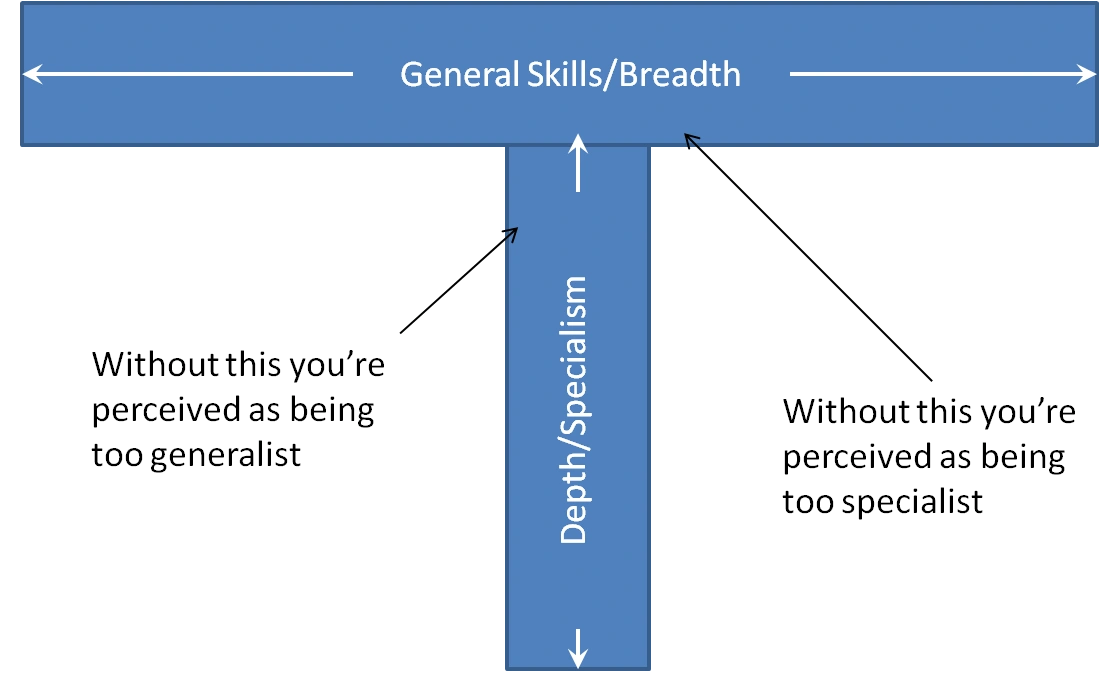
The old saying, "Jack of all trades, master of none" has a bit of a ring to it. We generally use this as a disparaging remark about a colleague or about ourselves in a self-effacing way. Sometimes being able to do a little bit of everything is positive in a manager, but ultimately you do need to 'hang your hat' on an area of the business. People that can do this are T-shaped. A T-shaped employee is an individual that has deep knowledge and skills in a particular area of specialisation, along with the desire and ability to make connections across disciplines. The horizontal bar of the T symbolises a breadth of general knowledge, soft skills and business acumen, while the vertical stem of the T symbolises technical depth.

Essentially, a T-shaped individual is both a niche-topic specialist and a generalist with people and business skills.

The T-shaped employee diagram

Today in information technology, T-shaped employees are in great demand because of an increasing convergence of technologies and changes in software development and delivery models. For some software development jobs, such as those that involve DevOps for example, the ability to work in a multidisciplinary team is essential. This contrasts with the I-shaped skills model that information technology departments valued in the past — one in which an employee's depth of knowledge in one niche area of IT was valued above all else.

One approach to ensuring that a company has employees with the required knowledge and skills for success is to encourage projects that break down silo walls and create an organisational culture that nurtures soft skill development. In such a working environment, employees will naturally gain general knowledge and develop people skills as they continue to build the in-depth knowledge required to support the company's business goals. The term T-shaped employee was popularised by Tim Brown, the CEO of the IDEO, a California design firm known for its collaborative and innovative workplace practices.

Change

How do you set about building a shared vision?

How do you set about building a shared vision?

The content of this article was dynamically rendered on the original site and could not be fully recovered during migration. We are working to restore it. Please check back soon.

LeadershipProject ManagementTeam

Are you a Leader or a Manager? What's the Difference?

Are you a Leader or a Manager? What's the Difference?

If you ask people about the differences between leaders and managers, there's a remarkable consistency of response.

Mark Bezos, Jeff Bezos, Oliver Daemen, Wally Funk (c) BLUE ORIGIN

People know the differences intuitively. John Kotter has studied the differences between management and leadership in the context of change, extensively, and his research underpins this summary:

Andrew Carnegie, the famous Scottish-American industrialist and philanthropist was certainly a leader with vision. He was less known for his amazing eye for detail, his own subject matter expertise, and his ability to get the most out of other experts. Leaders and managers are both result-oriented, both must delegate effectively, and both are essential to the effective running of an organisation. Broadly speaking though the differences can be summarised as follows:

"Management is doing things right; leadership is doing the right things." — Peter Drucker

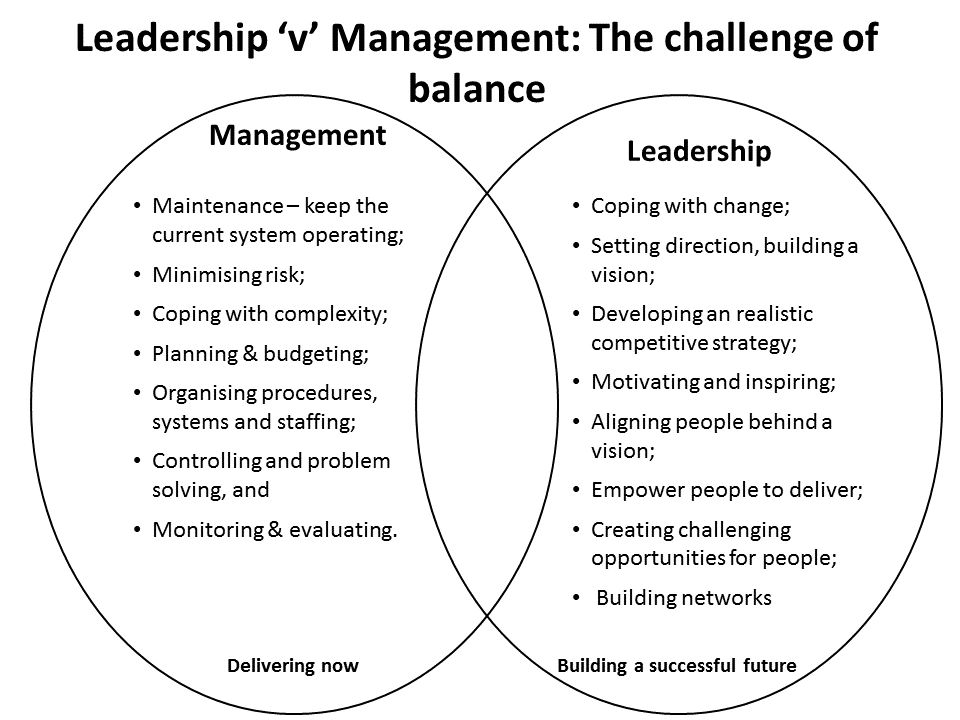
Leadership versus Management comparison

Managers fix problems and maintain — Managers are concerned with solving complex problems to keep things on track. They are task-oriented and concerned with the technical aspects of the job. They develop skills in planning, prioritising, budgeting, organising, practical implementation and meeting deadlines is vital for success as a manager. Managers understand the tools and techniques of quality. Managers' focus is on the immediate and on the current business cycle. They tend to base their authority on their subject matter expertise but this leads to under-delegation of matters within their own expertise and over-delegating matters that don't interest them. A typical management trait is the ability to maintain the status quo.

Leaders are concerned about change — Leaders primarily focus on a vision for the future and how to take people and the organisation with them. They focus on the human aspects, the processes and the underlying principles of the business. They develop skills of organisational scanning and seek information widely rather than deeply to foster a strategic approach. Leaders develop high-level conceptual skills, personal values and good interpersonal skills and tend to constantly learn and develop. Leaders tend to focus on long-term opportunities and the future needs of the business. They focus on themselves and resolve tensions and personal issues within themselves. Leaders have high self-esteem and deep confidence and an ability to articulate what they believe to be important. They deploy power and influence well. Leaders tend to base their authority on getting results from people who have greater expertise than they have. They develop staff and seek to constantly delegate to free up their time to develop the business, improve performance and tackle the competition. Leaders tend to be good at challenging the status quo, and they are highly visible and therefore vulnerable, and they act as role models for their beliefs.

It is important to acknowledge that in today's modern organisation, management and leadership activities need to be done by everyone. Organisations can't thrive without both sets of behaviours and if employees want a stake in the future success of an organisation, they probably need to develop both sets of skills.

Benefits

The Language of Benefits

The Language of Benefits

In looking for business benefits most organisations face similar issues. Finding and driving out benefits is like a 'leaky bucket', in that once initially delivered they quickly become difficult to trace and qualify. The bucket empties faster than you can fill it up. Many organisations have a poor history of benefits realisation and find it difficult and risky to fund the initial lump of investment required to deliver the benefits they're hoping for.

There are challenges that need to be understood and key amongst them is developing a mature understanding of the roles and differences between quick wins, silo-based and cross-cutting benefits. The key challenge is how to structure an affordable portfolio that is driven by efficiency, service, volume and capability. The key objectives of any benefits management and realisation approach are: realise a high percentage of targeted financial benefits and service improvements; seek to rigorously convert non-cashable to cashable benefits wherever possible; make any non-cashable benefits used to deliver tangible value, based on solid evidence; create the right sequencing and a balanced portfolio; and develop an effective and joined-up approach to benefits realisation.

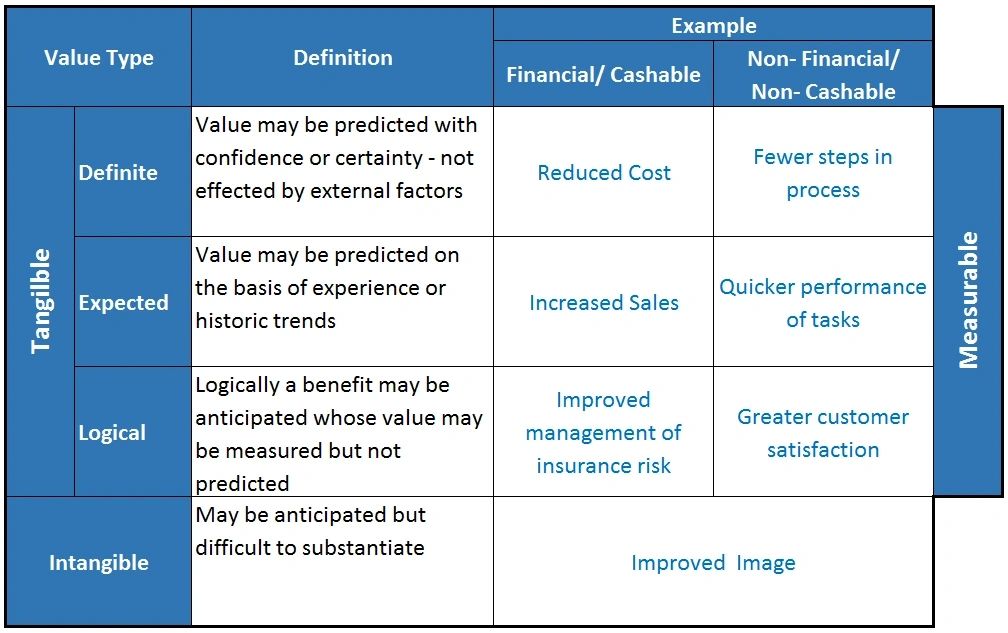
Language is important. Everyone involved in benefits-driven projects should be aware of and use an agreed nomenclature. One such common naming convention is as follows. First, we need to differentiate between tangible and intangible benefits.

A framework for the language of benefits — showing tangible and intangible benefit categories

Tangible Benefits — Tangible benefits are benefits that can be seen and felt. All tangible benefits can be measured, either in cash terms or by some other form of metric. Tangible benefits can be further subdivided as follows:

Definite: Definite benefits can be either cashable or non-cashable benefits, the value of which may be predicted with a high degree of confidence or certainty. Definite benefits are not affected by external factors. An example of a benefit that is tangible, definite and cashable (the best defined type of benefit) is the agreement of a new sourcing contract with a supplier. This is a cost reduction measure the value of which is very well defined with regards to monetary value and delivery date. This type of benefit can be included in operational budgeted planning and realised immediately. It should be possible to include the impact of a definite cashable benefit in upcoming or live budgets.

Expected: An expected benefit can be either cashable or non-cashable where the value of the benefit may be predicted and estimated on the basis of experience or historical trends. Increased sales are a good example of a tangible, expected cashable benefit. They may well be predicted based on experience, but they couldn't be 'baked in' to budgets until they have been realised. The delivery of training that delivers speedier performance of tasks may well be seen as a tangible, expected non-cashable benefit.

Logical: Cashable or non-cashable benefits that may logically be expected, the value of which may be estimated and measured but not predicted. Better management of risk that reduces insurance exposure should logically lead to reduced premiums.

Intangible Benefits — Intangible benefits are benefits that may be anticipated but are difficult to substantiate and measure. An example of benefits in this category would be improvements in public image. It is very difficult to measure, track and substantiate intangible benefits. Where quantification is difficult there is a tendency to avoid the difficult questions and to allocate benefits as intangible. However, there are a number of tools that can be effectively used to estimate benefits such as the 'Monte Carlo Box' and 'What if scenarios'.